# Why agent-written code needs a verifiable paper trail
Agent changes can lose the instructions, observations, and human decisions that explain them. Here is the evidence worth preserving and what verification can establish.
## Contents
Updated September 24, 2026 to clarify the current implementation.
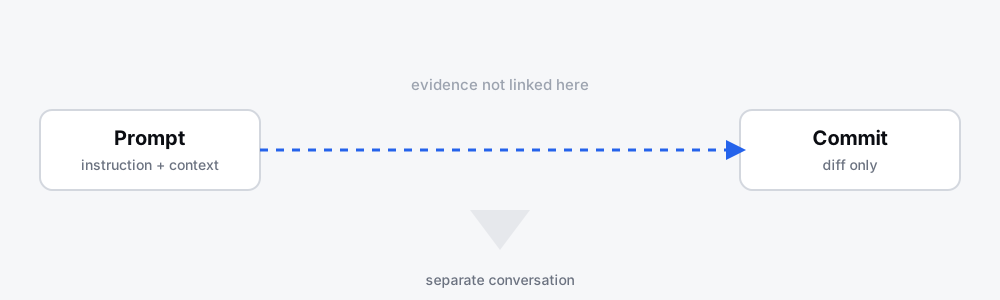
When an agent writes code, the diff reaches the repository. The instruction, files it read, checks it ran, and reasons a person accepted the result may stay in a separate conversation. Later, the team can see the change without the evidence needed to understand it.
That gap is one of the problems Logposa is working to close. It also makes PR fatigue worse: a reviewer has to reconstruct context before deciding whether a change is safe.
Keep the decision and its evidence
A useful record could connect a change to:
- the instruction the agent received and the constraints a person supplied;
- the files, tools, and test results that can be observed;
- the alternatives the author chose to document;
- the person who reviewed a particular version and the decision they made.
That record is more precise than calling everything “reasoning.” A model’s private reasoning may not be available, and a generated explanation is a claim that still needs checking. Observed actions, source material, and human decisions can be recorded and traced separately.
What “verifiable” should mean
A record should identify the exact change and evidence it describes. Its bytes can be hashed, signed by an accountable key, and checked later with the relevant public key and trust policy. That proves the signed bytes have not changed and identifies the key that endorsed them. It does not prove the record is complete or that every explanation in it is true.
The target is a trail that can be resolved and checked from the change, including when the verifier is offline. Today, Logposa has parts of that foundation: it links agent sessions to changes and verifies signed reconstruction revisions. A signed decision record attached to every commit is still a design goal, not a command you can run now.
If we get that link right, a team can revisit the evidence behind a change, distinguish a recorded human approval from its absence, and evaluate agent work against later outcomes. The next post describes the signing requirements and the current boundary of the implementation.